DON’T JUST MEASURE DISTANCE. MEASURE PARTICIPATION.
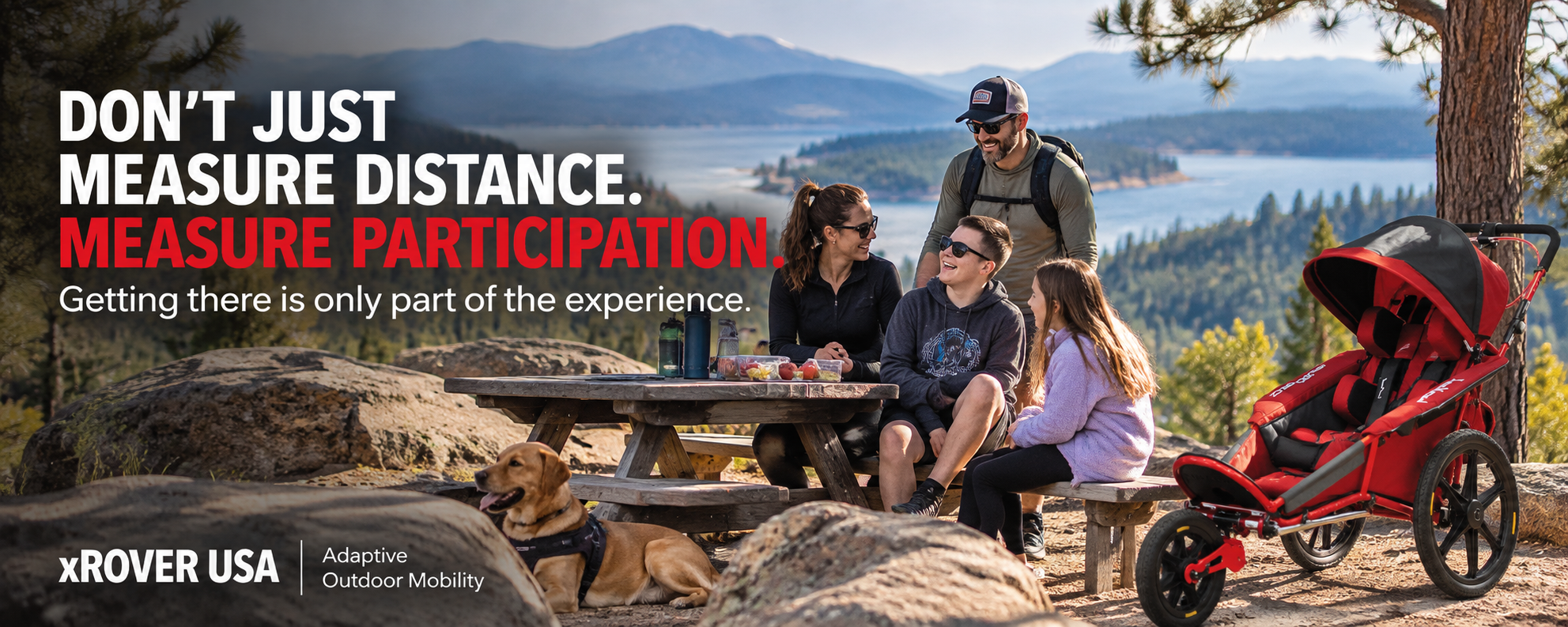
The success of a mobility solution isn’t only about how far someone can go. It’s about what becomes possible when they get there.
Mobility is often discussed in terms of distance.
How far can someone walk?
How long can they remain on their feet?
How much assistance do they need?
Those questions matter.
But they do not tell the whole story.
Because reaching a destination is only one part of participation.
What happens after you arrive matters too.
GETTING THERE SHOULDN’T USE EVERYTHING YOU HAVE.
Imagine a family heading to a community event.
There is a long parking lot.
A walk to the entrance.
Crowds.
Time spent exploring.
Another walk to an activity.
And eventually, the entire journey back.
A person may technically be capable of walking that distance.
But if getting there requires most of their available energy, what remains for the experience itself?
The same question applies to a park, a trail, a zoo, a family vacation, a sporting event, or simply a longer day in the community.
Mobility should help make participation possible — not become the entire challenge.
SAVE ENERGY FOR WHAT MATTERS.
For some ambulatory children, adolescents, and adults, supplemental mobility can provide an important option.
Walk part of the way.
Use support when distance or fatigue increases.
Rest while continuing to move with the family.
Then walk again when it makes sense.
The objective is not necessarily to minimize walking.
And it is not to maximize time spent using mobility equipment.
The objective is to use mobility strategically so more of the person’s energy can go toward life itself.
LOOK BEYOND POINT A TO POINT B.
At xROVER USA, we believe a mobility assessment should consider more than whether someone can physically travel from one point to another.
We also want to understand:
What happens at the destination?
Can they participate?
Can they stay longer?
Can they explore with their family?
Can they preserve enough energy for the activities they enjoy?
Can the family consider experiences they might otherwise avoid because of distance, terrain, fatigue, or safety?
These questions can reveal mobility needs that a simple walking-distance measurement may never capture.
THE DESTINATION ISN’T THE GOAL.
Participation is.
The park.
The trail.
The family trip.
The community event.
The afternoon together.
The experiences that become possible when mobility supports the person instead of consuming all of their available energy.
That is why our approach begins with real life and works backward toward the appropriate mobility solution.
DON’T JUST ASK HOW FAR THEY CAN GO.
ASK WHAT THEY CAN DO WHEN THEY GET THERE.
xROVER USA | Adaptive Outdoor Mobility
Ready to explore what may work for your family?
LEARN MORE → Personalized Recommendation
.png)