THINK ABOUT WHAT ACTUALLY HAPPENED
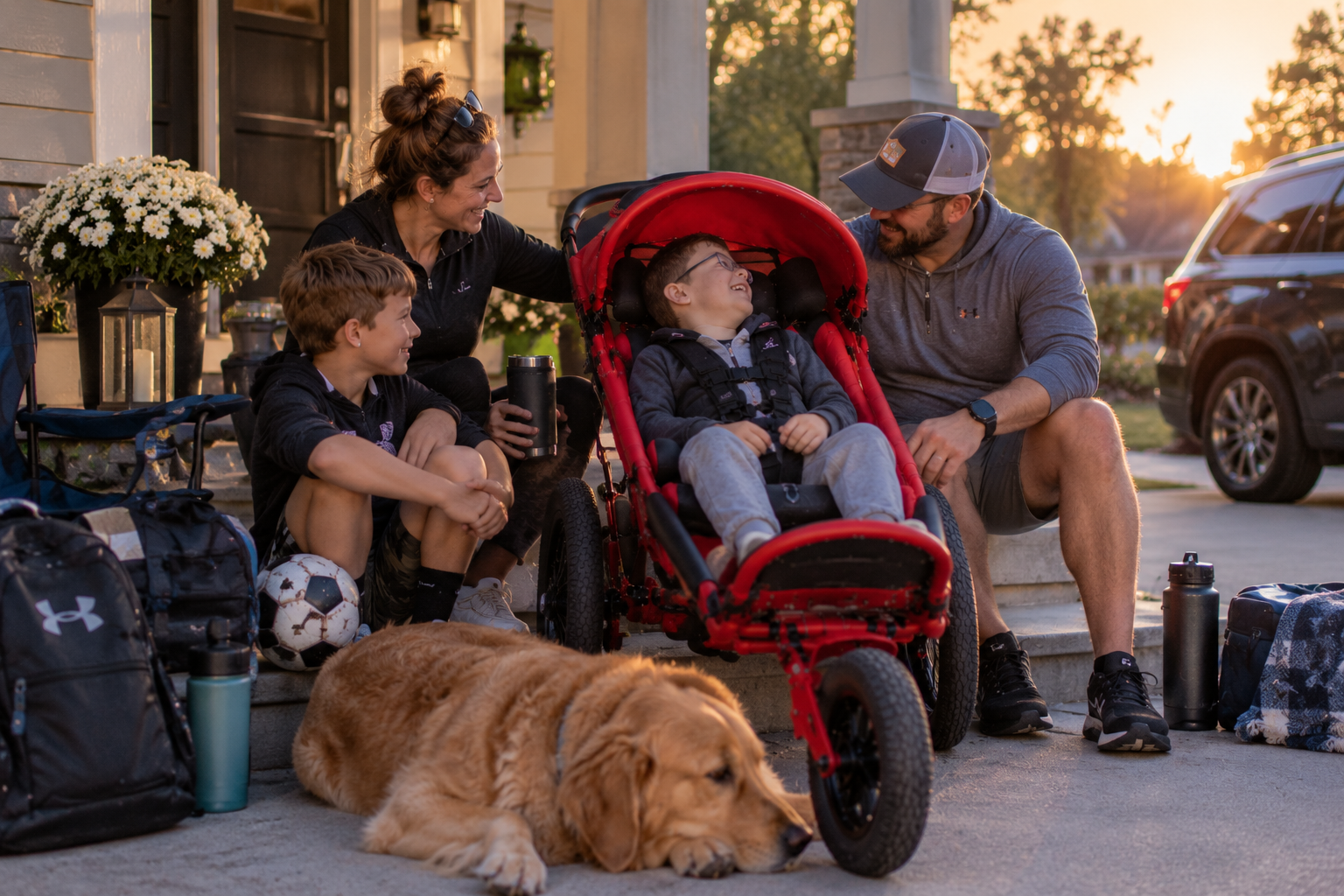
And what didn't.
Maybe your family spent the weekend at a park.
A soccer field.
A community event.
On a long walk.
Visiting friends.
Or simply enjoying more time outside.
Some moments were probably easy.
Others may have required more planning.
And sometimes, the moments that became difficult tell us something important about mobility.
Before the weekend ends, ask one question:
What would you like to make possible next?
Not what should have happened.
Not what a mobility device is supposed to do.
What actually happened.
Did everyone stay for the whole activity?
Was the distance comfortable?
What happened when the surface changed?
Did fatigue change the plan?
Did safety become a concern?
Was there somewhere the family wanted to go but decided not to?
Did someone have to leave earlier than everyone else?
These aren't failures.
They're information.
And real-life information can be incredibly valuable when thinking about mobility.
REAL LIFE CAN REVEAL THE GAP
A person may walk independently and still find longer community distances difficult.
Someone may use a wheelchair successfully every day and encounter very different demands when the environment changes.
Another individual may require significant mobility and positioning support throughout the day.
Every situation is different.
But sometimes a weekend makes one thing clearer:
There may be a gap between the mobility that works in everyday routines and the mobility needed for the life a family wants to live.
Recognizing that gap doesn't automatically tell us which equipment is appropriate.
But it gives us a much better place to start.
DON'T START WITH THE PRODUCT
If something was difficult this weekend, you don't need to immediately start comparing equipment.
Start with the experience.
Maybe the problem was distance.
Maybe terrain.
Fatigue.
Safety.
Positioning.
Transportation.
Or simply the length of the day.
Understanding what changed the experience is more useful than beginning with:
“Which stroller should we buy?”
At xROVER USA, we prefer a different starting point:
Tell us what happened.
FOUR QUESTIONS ARE ENOUGH TO BEGIN
You don't need to send us every medical document.
You don't need to know the correct xROVER size.
You don't need to understand every configuration.
And you don't need to have funding figured out.
To begin, tell us:
1. Who would use the xROVER?
2. How do they currently move through everyday life?
3. Where does mobility become difficult?
4. What would you like to make possible?
That's enough for the first conversation.
From there, our team can ask the right follow-up questions based on the individual situation.
MAYBE THE NEXT STEP ISN'T MORE DISTANCE.
Maybe it's more time.
More participation.
More flexibility.
More opportunities to join siblings.
More confidence saying yes to an outing.
Or simply having another option when the environment changes.
That's why the question isn't only:
“How far can we go?”
It can also be:
“WHAT WOULD WE LIKE TO BE PART OF?”
BEFORE THE WEEKEND ENDS...
Think about one moment from the last two days that you would like to make easier next time.
That's where we can start.
WHAT WOULD YOU LIKE TO MAKE POSSIBLE NEXT?
Tell the xROVER USA team about your real life.
We'll help determine whether xROVER may be an appropriate direction — and what the next step should be.
START YOUR PERSONALIZED RECOMMENDATION →
Or speak directly with our team:
📞 +1 (941) 278-2882
✉️ peter.kral@ixroverfl.com
xROVER USA
Adaptive Outdoor Mobility Specialist
Supporting families across the United States & Canada